
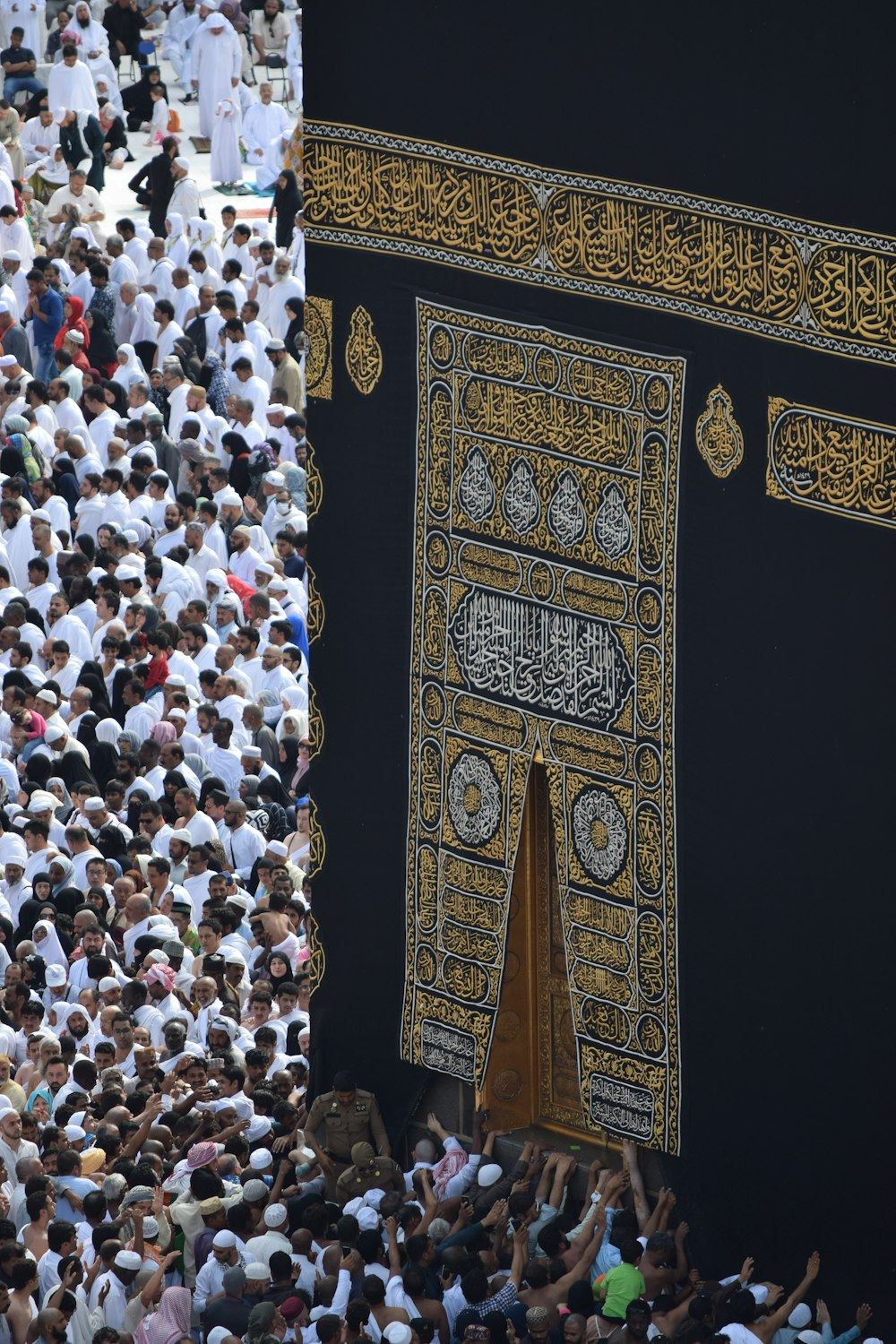

Nothing prepares you for the first sight of it. You come down the marble steps of the Haram with a crowd pressing gently from behind, the recitation of the imam echoing off the arcades, and then the roof opens and there it is: a plain black cube, smaller than you imagined, perfectly still while two million people move around it. Most of us will stand there only once in our lives. Yet the rites that unfold around the Ka‘bah – tawaf, sa‘i, ‘Arafah, the stoning – are not meant to be a private spiritual summit. They are a curriculum, written in movement, for how a Muslim is supposed to live in Dallas or Dubai or anywhere else in the other fifty-one weeks of the year.
“And proclaim unto mankind the pilgrimage. They will come unto thee on foot and on every lean camel; they will come from every deep ravine,”
Quran 22:27 · Pickthall
01Tawaf: the discipline of orbit
Tawaf is the first thing a pilgrim does and the last. Seven circuits, anticlockwise, the Ka‘bah always on the left – and nothing else. There is no fixed du‘a for each round, no required recitation beyond what the heart offers. The rite is almost stubbornly simple, and that is its lesson. A believer's life is meant to have a fixed centre and a steady orbit: five prayers that return us to the same point whatever the day has done to us, a Friday that pulls the week back into shape, a Ramadan that rights the year.
02Sa‘i: effort with the outcome in Allah's hands
Between Safa and Marwah a mother once ran seven times searching for water for her infant son, and found none. The water came from under the child's feet, where she was not looking. Hajar's sa‘i is a rite that commemorates a woman, and Allah made it a mark of His religion (Quran 2:158). Its lesson is precise. We are commanded to strive – to walk, to run between the green lights, to exhaust the means we have – but we are never promised that the means will produce the result. For a parent worried about a child's schooling, a graduate sending out applications, a shop owner in Richardson watching a slow month, sa‘i is permission to work hard without despair and to succeed without arrogance.
03‘Arafah: an afternoon of nothing but asking
The Prophet ﷺ said, “Hajj is ‘Arafah” (Tirmidhi 889). Not the Ka‘bah, not the stoning – a bare plain outside Makkah where, for one afternoon, the pilgrim stands, faces the qiblah and asks until sunset. Our worth before Allah is not measured by output. Those of us at home fast on this day, and the Prophet ﷺ said that it expiates the sins of the year before and the year after (Muslim 1162).
“Whoever performs Hajj for Allah's sake and does not speak obscenely or commit sin returns as on the day his mother gave birth to him.”
Sahih al-Bukhari 1521
04The stoning: naming the enemy and moving on
On the morning of Eid the pilgrim throws seven small pebbles at a pillar. The pebbles are tiny – the Prophet ﷺ insisted on it, warning against exaggeration in religion (Nasa'i 3057) – and that is the point. Our daily battles with temptation are rarely dramatic. They are small, repeated, and best fought by naming the whisper for what it is before it becomes a conversation.
Few of us standing in the Haram will remember the fiqh details a year later. But the shape of the rites stays: a fixed centre, honest effort, an afternoon of asking, and a handful of pebbles for the small enemies of the ordinary day. That shape fits a life in Texas as well as it fits a tent in Mina.
References
- Quran 22:27
- Quran 2:158
- Sahih Muslim 1218
- Jami‘ at-Tirmidhi 889
- Sahih Muslim 1162
- Sahih al-Bukhari 1521
- Sunan an-Nasa'i 3057